

Formula Monza 875
This was the entry-level racing formula. It was called Monza 875 because the cost of a car was capped at 875,000 lire and Monza was the circuit available.
The cars took their engine, gearbox, axles, brakes, wheels and more from the Fiat 500 estate.

First collective outing: 11 April 1965
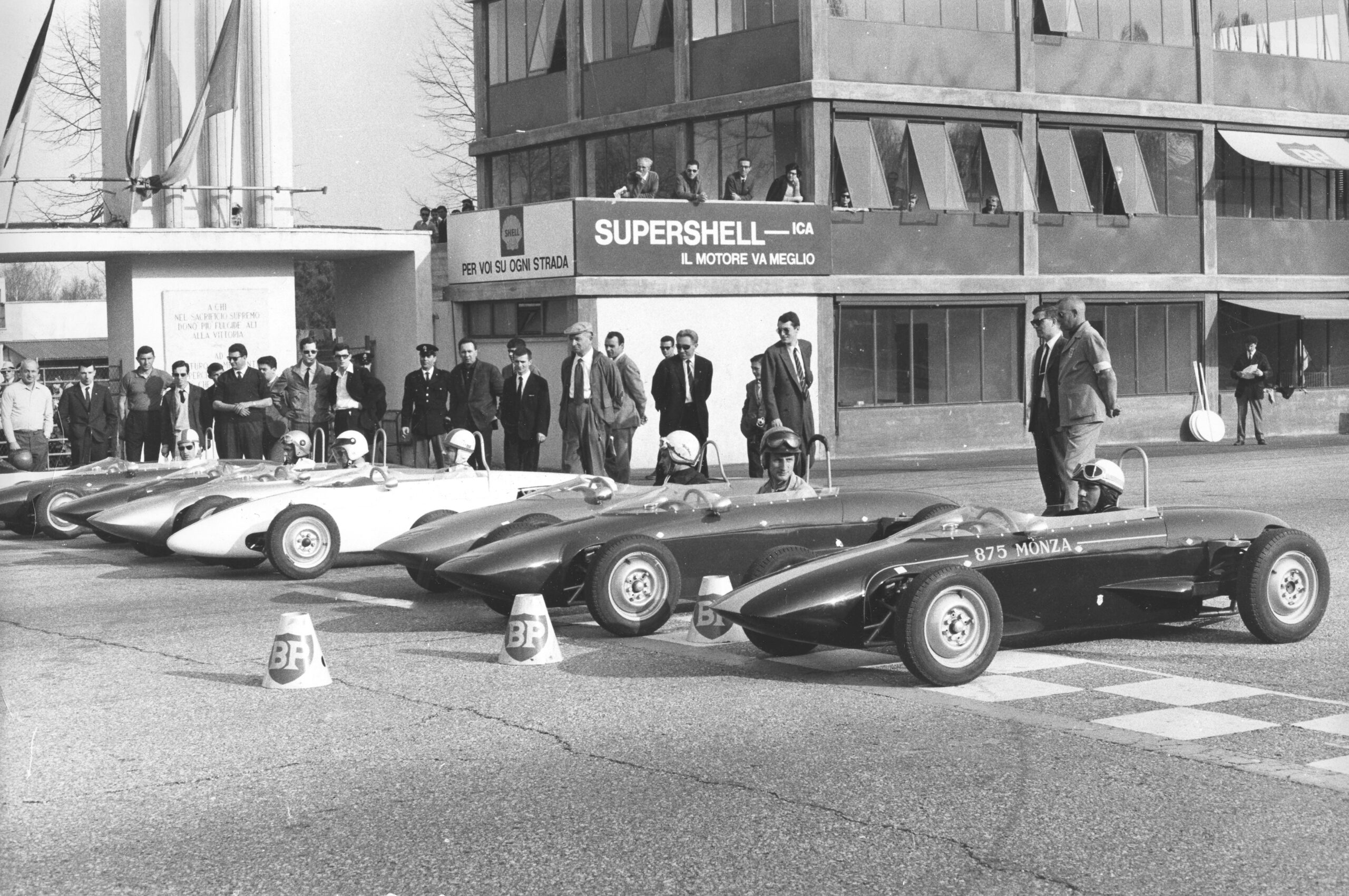
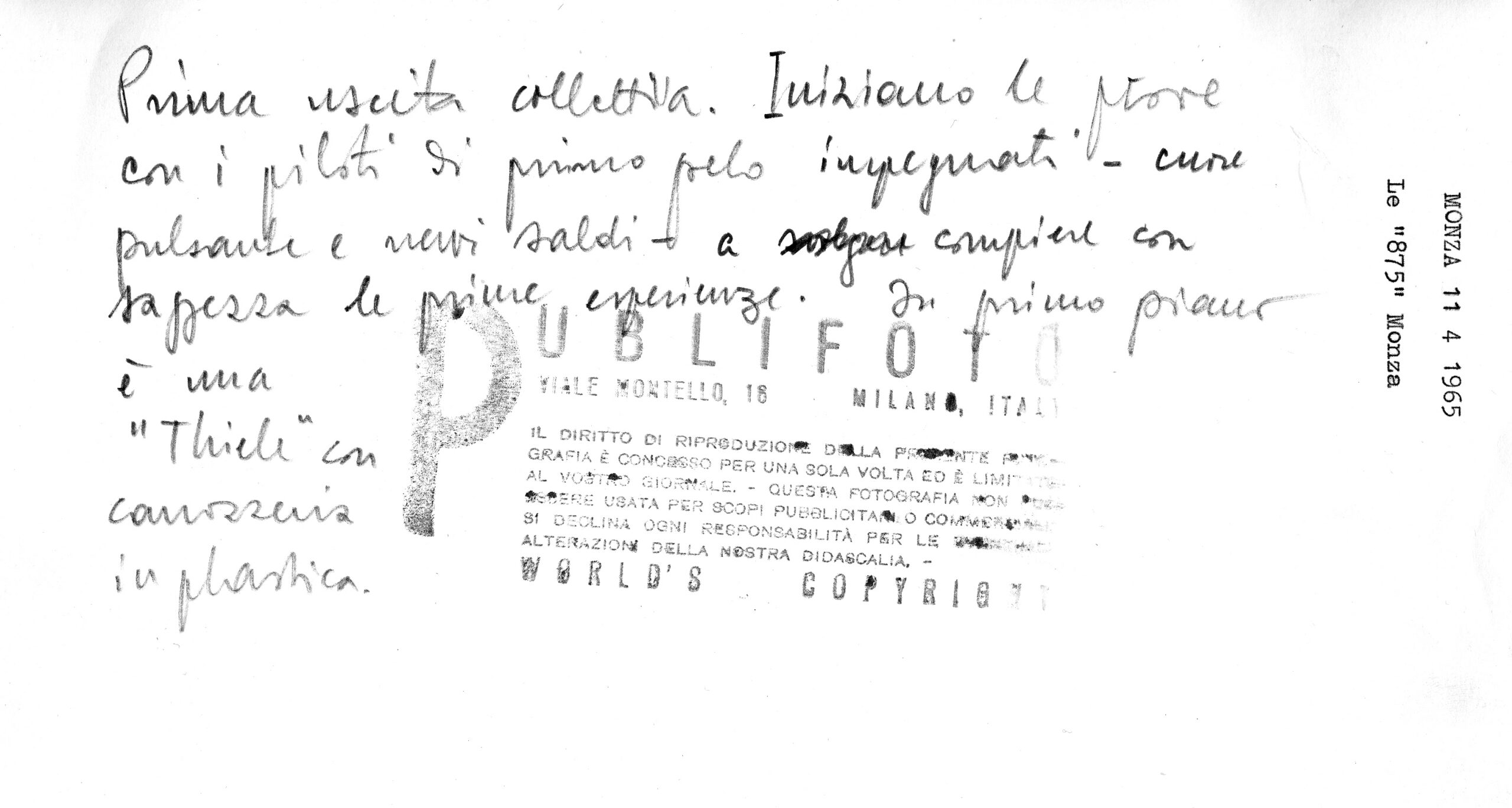
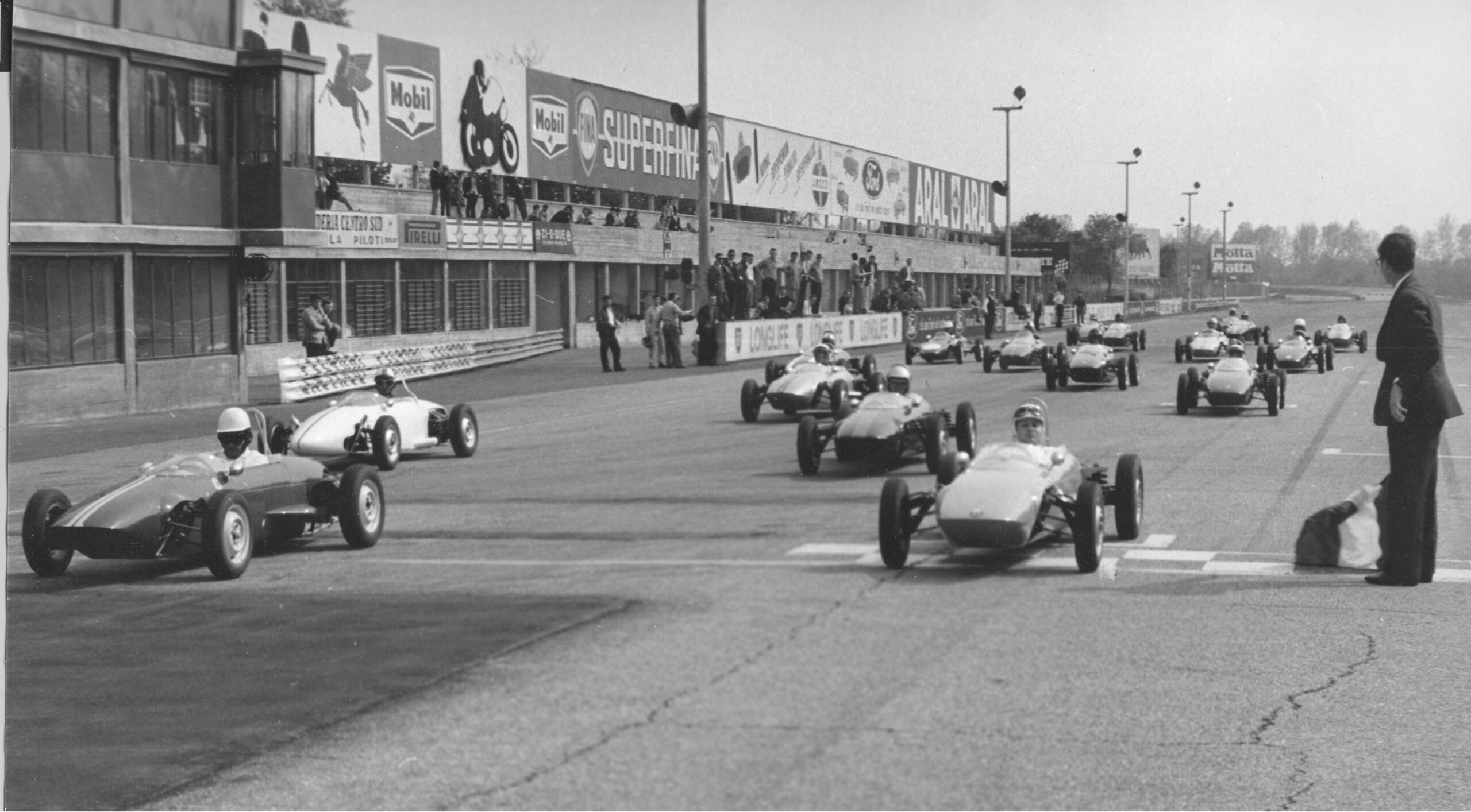
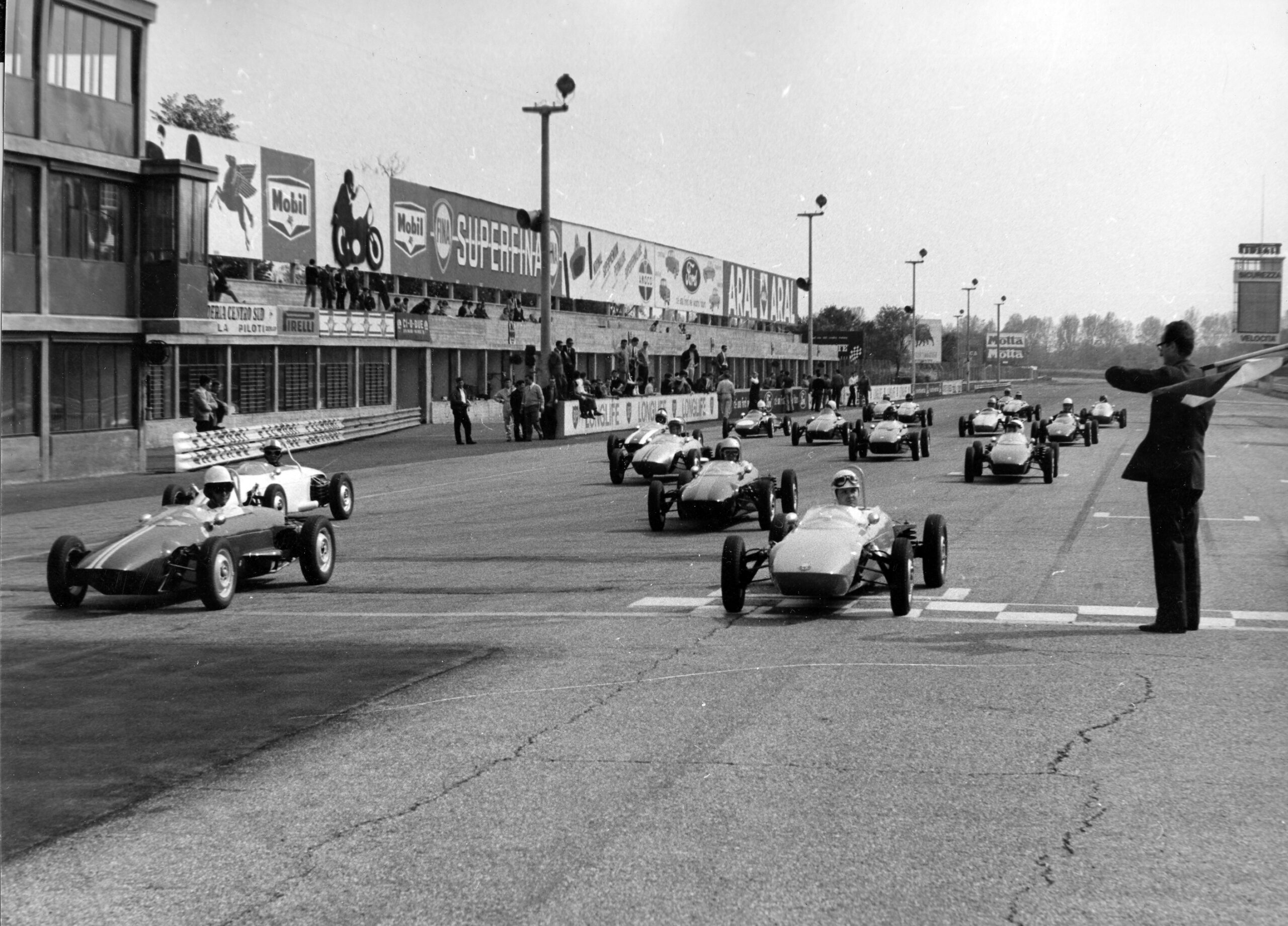
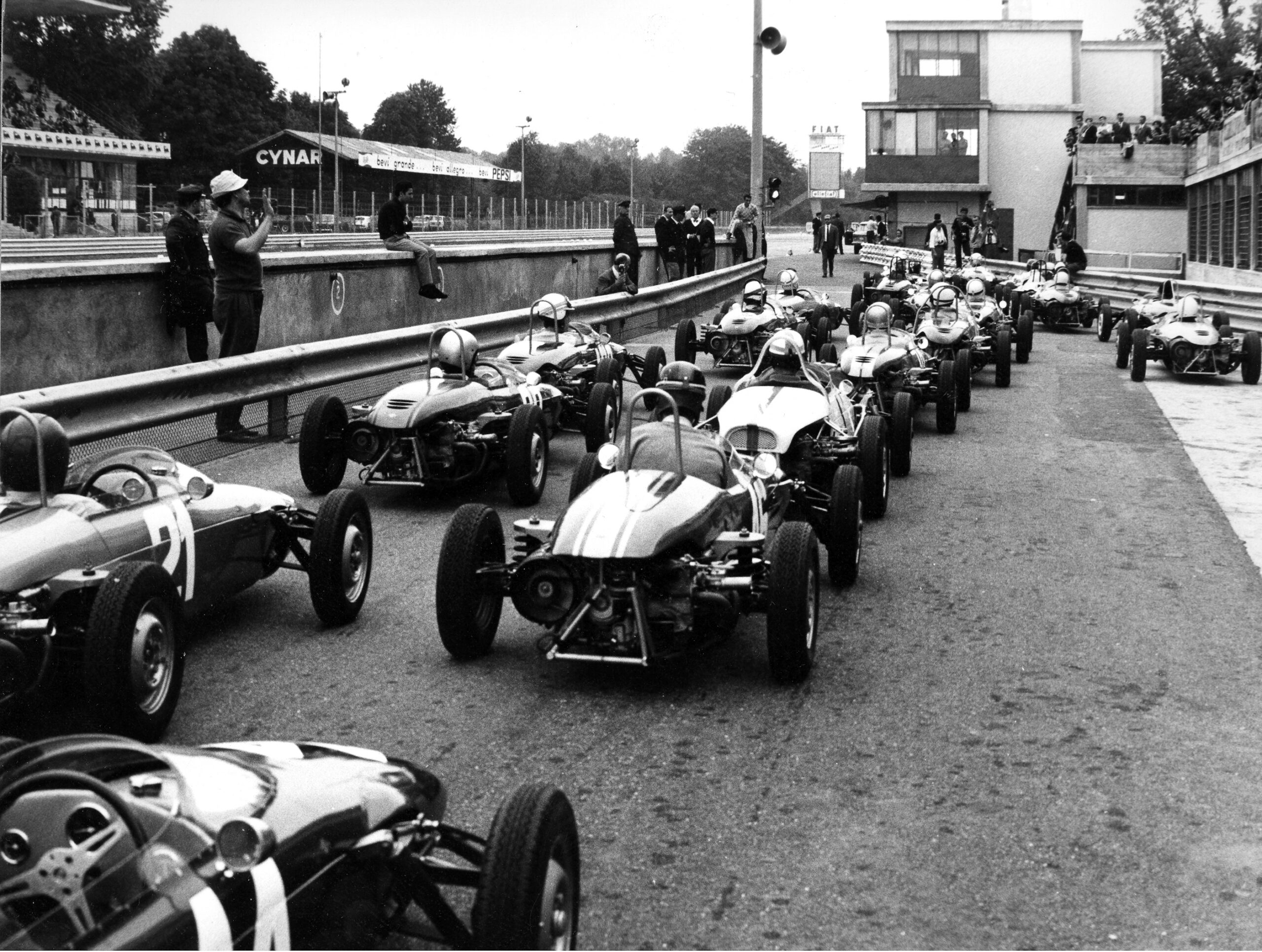
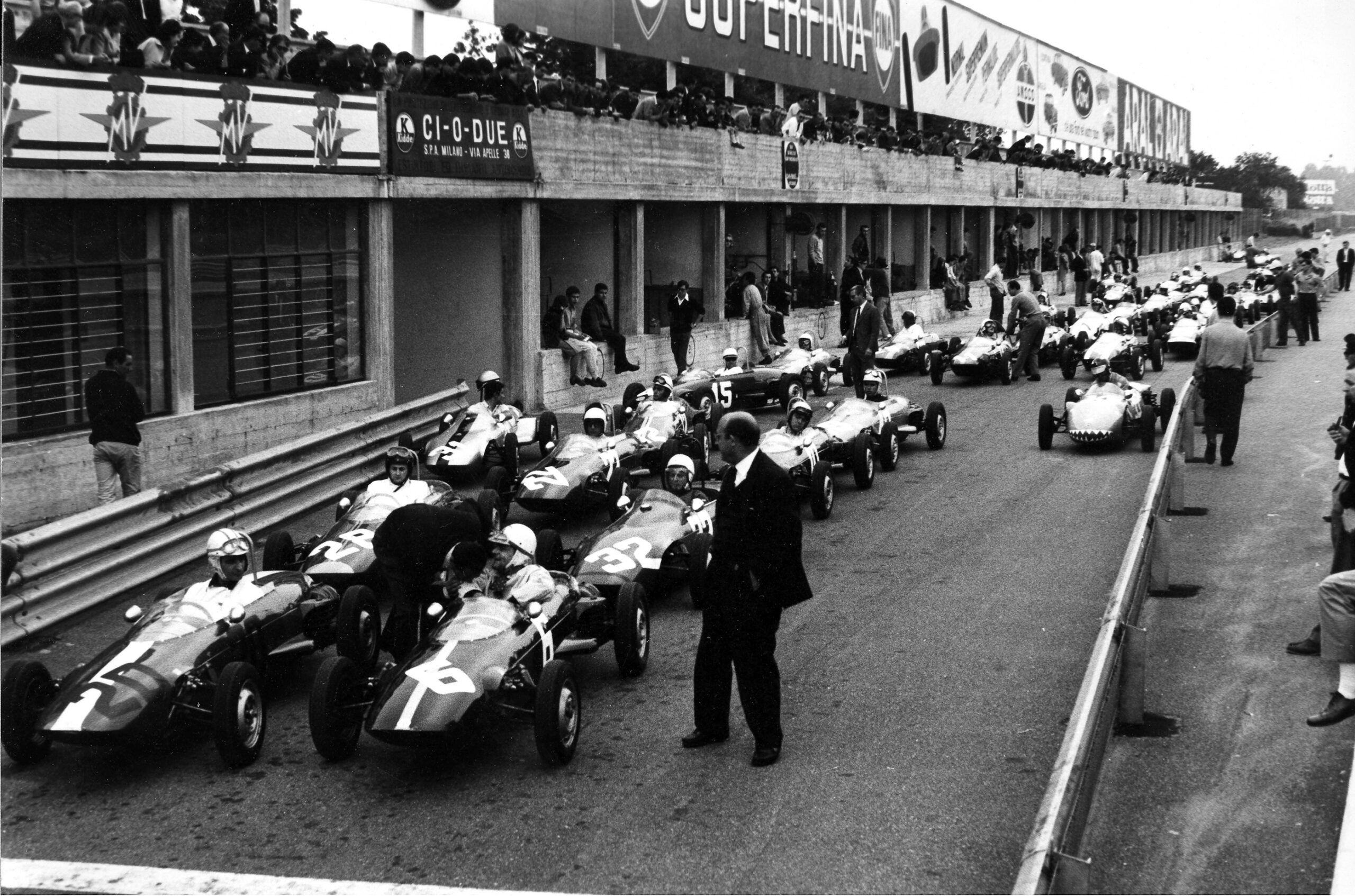
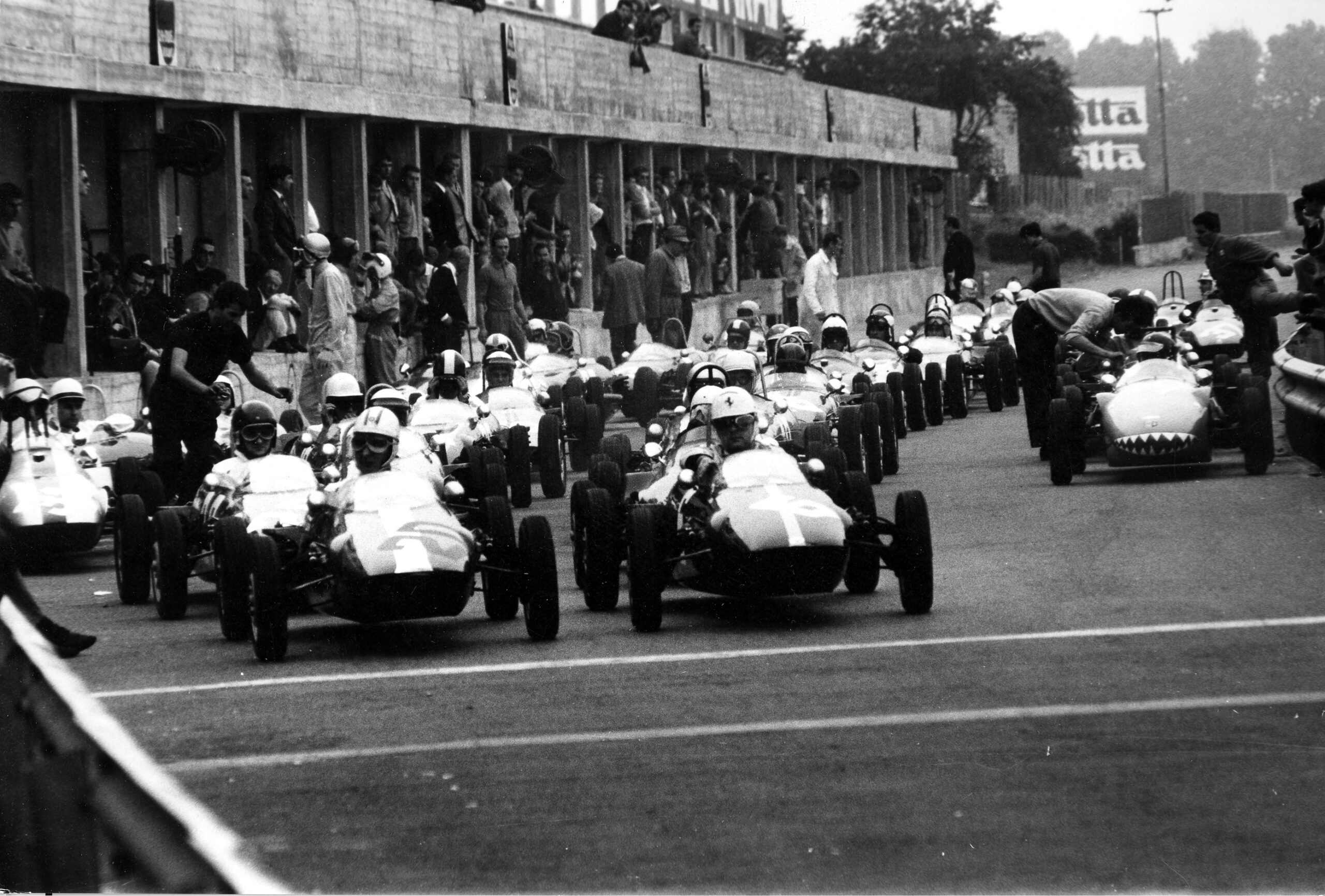
On 11 April 1965 the cars first went out together on the Pista Junior. The back of a press photograph calls it «prima uscita collettiva» – a first collective outing, with the beginners at the wheel for their first practice. It was not yet a race: the first Trofeo Cadetti followed in May.
Impressions
How the formula came about
The formula was created in Milan in 1964. The idea came from Luigi Bertett, president of the Automobile Club Milano; it was carried out by Romolo Tavoni, the former sporting director of Ferrari and ATS, who joined the AC Milano early in 1964. The brief was to create a training formula that would bring sporting and technical activity to the Monza autodrome all year round.
It was meant to be a school not only for drivers, but also for mechanics, constructors, engine tuners, organisers and marshals. The setting was the Pista Junior at Monza, built in 1963: a short circuit with low running costs, intended for national races.
The chassis
The design came from Ing. Alberto Massimino, at the time a consultant to Ferrari and Maserati; it was drawn by his draughtsman Molinari. It called for a tubular frame with a wheelbase of 1950 mm. The suspension came from the Fiat 500 Giardiniera: a transverse leaf spring acting as the lower link at the front, the Fiat box-section trailing arms at the rear. Hubs, drum brakes, wheels and steering box were Fiat parts as well.
The design was deliberately neither signed, nor registered, nor patented, so that anyone able to do so could build one. Only the overall dimensions, the wheelbase and the prescribed production parts had to be respected. That is exactly what produced the large number of small constructors that characterises this formula.
Tavoni had previously been Enzo Ferrari’s personal secretary. He asked Massimino for a chassis that “anyone with a little mechanical sense” could build themselves. The tuners put in an estimate of one million lire — Bertett held firm at 875,000.
The engine
The choice fell on the flat-twin of the Fiat 500 Giardiniera, the «motore a sogliola», recommended by Aurelio Lampredi in April 1964: a very low centre of gravity, gearbox and rear axle staying attached to the engine, and air cooling that saves the radiator. His conditions were not to make the chassis too short and to match the weight distribution to the overhung engine.
The first stage of tuning came from Almo Bosato: valves, stronger valve springs and polished inlet ports gave around 5 hp; with the ancillaries removed, a free exhaust and altered carburation, engine speed rose by more than 1000 rpm and the gain reached at least 10 hp.
The three prototypes
Three prototypes were built – one white, one red, one green like the Italian flag – at 1,200,000 lire each. The aluminium body came from Fantuzzi, the frames from the Modenese craftsmen Giuliano Luppi, Giovanni Manfredini and Girolamo Gibertini. In April 1964 the red car stood for a fortnight in a Milan shop on Via Montenapoleone, then for a month at the Arengario and for another month in the main hall of the Automobile Club Torino.
After the prototype builders, the production frames were made by Manicardi e Messori of Modena, with the bodywork remaining with Fantuzzi. Thiele in Novara took a mould from the aluminium body and produced it in plastic.
The name «875»
The number 875 is not a capacity, it is a price. Luigi Bertett laid down that a race-ready car should cost 875,000 lire: «We shall call it 875 Monza, because it will cost 875 thousand lire. That way the price becomes the name and cannot be moved.» The engine remained the twin of the Fiat 500 Giardiniera; after it the class was also called «Formula Monza 500».
The parts alone cost between 720,000 and 750,000 lire, the rest being labour and a very small profit. Cars were ordered through any ACI sporting office with a deposit of 200,000 lire and a delivery time of about two months. A CSAI subsidy of 250,000 lire and the option of paying in instalments were available as well.
How far prices later fell is shown by an announcement from 1972: Repetto offered Formula Monza chassis for no more than 350,000 lire.
Regulations and technology
The regulations left little room. Chassis, wheelbase and the prescribed production parts were fixed, only limited work on the engine was allowed, and every part had to be of Fiat manufacture.
| Chassis | tubular frame to Alberto Massimino’s design |
|---|---|
| Wheelbase | 1950 mm, mandatory |
| Engine | flat-twin from the Fiat 500 Giardiniera, overhung at the rear |
| Permitted work | valves, valve springs, compression ratio, camshaft, lightening and balancing of rotating parts; all parts of Fiat manufacture |
| Carburettor | horizontal instead of the standard vertical unit |
| Exhaust | free |
| Brakes | drum brakes from the Fiat parts shelf |
| Aerodynamic devices | always prohibited |
| Output in 1965 | about 5 to 10 hp above standard |
| Output in 1967 | 25 to 26 hp at most |
| Output in 1968 | 28 hp (Gatto), 31 hp at 7200 rpm (Colombo) |
| Top speed early on | 145 to 150 km/h |
| Top speed in the final years | 170 to 180 km/h |
| Average lap speed | around 120 km/h |
Scrutineering was strict from the start. The first technical commissioner was Vincenzo «Cino» Galmanini of the CSAI technical commission. There was a viewer listing all permitted Fiat part numbers; the parts fitted had to match the declared serial numbers. Weight, wheelbase and track were checked – a lift was bought for the purpose. In post-race checks cars were regularly excluded from the results because their engines were not in order.
Later, individual constructors reversed the engine position and moved it ahead of the rear axle. Corsini, Santandrea and the «Bartolina» of the Bartoli brothers are named for this; who did it first is not clearly recorded.
In the drivers’ slang the cars were called «monzini» or «petarelle», after the sound of the air-cooled twin.
The minimum weight was 375 kg with the driver. Cars ran on Pirelli Cinturato CN34 tyres, 125 × 13 at the front, 135 × 13 at the rear. With the transverse leaf spring at the front and the rear half-axles, the tubular frame kept the Giardiniera’s track widths.
Anyone could buy their engine where they liked, so long as the parts came from the catalogue. Since 875,000 lire was tight, many got theirs from the scrapyard.
The racing
In the best years, around 1980, four qualifying heats were run; the first six from each went into a final with twenty-four places.
The championship was called Trofeo Cadetti. The first year, 1965, was backed by Shell; from the second year the sponsor was Agip, hence Trofeo Cadetti Agip. From 1966 the series was recognised by the CSAI as a Trofeo Nazionale, a status that lasted until 1991. In 1966 the Coppa nazionale CSAI was added, with rounds held outside Monza as well.
Racing took place on the Pista Junior, as a rule ten rounds per season. A race day consisted of two or three heats – the batteries – and a final. In 1965 there were two heats of 15 laps and a final over 20 laps with twenty cars admitted; in 1970 the heats covered 15 laps (35.778 km) and the final 20 laps (47.700 km). In 1968 points were awarded on the scale 9 / 6 / 4 / 3 / 2 / 1.
The grid for the heats was drawn by lot, with tombola balls pulled by three different drivers each time in front of a sporting steward. The idea was that the fastest should not always be favoured; qualifying practice came only much later. Only towards the end of the 1973 season did the first six from the previous round start from the front row, while the draw remained in force for the other rows.
The fields were large: on average some eighty cars per race, at times more than a hundred. For the final round of 1972, 54 drivers were entered. The busiest season was 1978, with 880 entries across ten rounds. On one Thursday evening more than 5500 paying spectators attended.
At first racing took place on Thursday afternoons. The lighting of the Pista Junior, designed by Philips, was inaugurated at the end of the summer of 1965, after which the races were held on Thursday evenings. Later they moved to Saturday evening and finally to Saturday afternoon.
Nobody grew rich on it: in 1970 the 850 and 875 Monza classes together were competing for 300,000 lire – 100,000 lire and a medal for each of the first three.
The seasons
The champions
The Trofeo Cadetti was run eighteen times, from 1965 to 1982. The list comes from Massimo Campi’s book Correvamo con i formulini; the makes from 1974 on from the podiums printed there, the earlier ones from our own sources.
| Year | Champion | Car |
|---|---|---|
| 1965 | Maurizio Montagnani | Gibertini & Oleari |
| 1966 | Franco Guffanti | CRM |
| 1967 | Luigi De Negri | LAB |
| 1968 | Mario Gatto | CRM |
| 1969 | Mauro Ghisleri | Repetto |
| 1970 | Ferdinando Spreafico | Repetto |
| 1971 | Domenico Tagliabue | Repetto |
| 1972 | Orazio Ragaiolo | RGB |
| 1973 | Aldo Cavallini | LAB |
| 1974 | Leo Bartoli | Melesi |
| 1975 | Riccardo Calegari | Melesi |
| 1976 | Angelo Sonvico | S.A.A.V. |
| 1977 | Enrico Mandelli | Melesi |
| 1978 | Filippo Baj | Melesi |
| 1979 | Romeo Maestri | Melesi |
| 1980 | Salvatore Maccarone | Santandrea |
| 1981 | Giovanni Brusadelli | MGB |
| 1982 | Luciano Schiatti | Repetto |
Alongside it, from 1966, ran a second championship, the Coppa Nazionale CSAI — also contested away from Monza and in hillclimbs. From 1968 on the same driver won both titles every year.
| Year | Winner |
|---|---|
| 1966 | Maurizio Montagnani |
| 1967 | Fabrizio Viscardi |
| 1968 | Alberto Colombo |
| 1969 | Mauro Ghisleri |
| 1970 | Ferdinando Spreafico |
| 1971 | Domenico Tagliabue |
| 1972 | Orazio Ragaiolo |
| 1973 | Aldo Cavallini |
After 1982 the formula ran two more seasons as the Trofeo FISA delle Scuderie Lombarde: 1983 Giampaolo Bizzotto, 1984 Giorgio Ghezzi — the last champions of Formula Monza.
1964 – the running-in year
No race was held in 1964. By early May there were already numerous orders, and a few weeks later the first drivers were lapping the circuit. Access to the track was free; the only condition was to buy fuel at the autodrome’s filling station. The drivers came on Thursday afternoons.
1965 – the first championship
At the end of April 1965, 72 cars were on order:
| Manufacturer | Orders |
|---|---|
| CRM, Modena | 38 |
| Plastic Thiele, Novara | 22 |
| Ambiveri, Milano | 4 |
| Bianchi, Genova | 2 |
| Amilcar, Genova | 2 |
| Oleari, Magenta | 1 |
To these was added a young Milanese engineer determined to build his car himself.
The first round was run in two heats and a final; the heats were won by Walter Frodi and Maurizio Montagnani. The champion was Maurizio Montagnani. Accounts of his car differ: a Gibertini & Oleari is named, and also a CRM reworked by Oleari and Gibertini. Second was Enzo Corti on a Thiele, third Pino Pica on a CRM.
The prizes were presented by the president of the CSAI. Enzo Ferrari came in person and honoured the runner-up in the championship.
The entry list of the first race
The entry list of the 1ª Coppa Cadetti 875 Monza of May 1965 survives — with race number, driver, team and car. 48 entries; numbers 13, 17 and 47 do not appear in the list.
| No. | Driver | Team | Car |
|---|---|---|---|
| 1 | Maurizio Montagnani | — | Gibertini & Oleari |
| 2 | Pierdanilo Vallardi | Scuderia Metropoli | Ambivero |
| 3 | Enrico Forti | Mirabella Mille Miglia | MZ |
| 4 | Alberto Boniardi | S. Ambroeus | C.R.M. |
| 5 | Giovanni Boeris | Nord Ovest | Thiele |
| 6 | Alessandro Angeleri | — | C.R.M. |
| 7 | Lino Baldini | — | Repetto |
| 8 | Giovanni Bianchi | Madunina | C.R.M. |
| 9 | Luigi De Negri | — | C.R.M. |
| 10 | Franco Guffanti | Jolly Club | C.R.M. |
| 11 | Marcello Curioni | del Lario | C.R.M. |
| 12 | Arnaldo Bernacchini | Jolly Club | C.R.M. |
| 14 | Giuseppe Bianchi | Madunina | C.R.M. |
| 15 | Aldo Maggi | S. Ambroeus | Thiele |
| 16 | Sergio Boffo | — | Thiele |
| 18 | Guido Anversa | — | C.R.M. |
| 19 | Duccio Castelli | Jolly Club | C.R.M. |
| 20 | Gianni Adani | Jolly Club | C.R.M. |
| 21 | Pierantonio Colombo | Madunina | M.Z. |
| 22 | Giovanni Gussoni | Madunina | Tinarelli |
| 23 | Giampaolo Monti | — | Tinarelli |
| 24 | Luigi Padulo | — | Thiele |
| 25 | Luciano Pavesi | — | L.A.B. |
| 26 | Sergio Zerbini | — | C.R.M. |
| 27 | Giuliano Pettenon | Madunina | Tinarelli |
| 28 | Giorgio Recordati | Jolly Club | C.R.M. |
| 29 | Lella Lombardi | Moroni | C.R.M. |
| 30 | Vittorio Reposi | — | Repetto |
| 31 | Alessandro Visciani | — | Thiele |
| 32 | Bruno Rovelli | — | Repetto |
| 33 | Giovanni Salvati | — | Ambivero |
| 34 | Luigi Scalini | Jolly Club | C.R.M. |
| 35 | Paolo Vargiu | — | Tinarelli |
| 36 | Graziano Rigo | — | C.R.M. |
| 37 | Fabrizio Viscardi | — | Stilauto |
| 38 | Roberto Franco | — | C.R.M. |
| 39 | Stefano De Santi | Piloti Senesi | C.R.M. |
| 40 | Carlo Motto | — | Thiele |
| 41 | Mario Pucci | — | Thiele |
| 42 | Euro Granini | Arcangeli Bandini | C.R.M. |
| 43 | Santino Pancotti | — | C.R.M. |
| 44 | Avantiero Bresci | Gr. Piloti Pistoiesi | C.R.M. |
| 45 | Ugo Cancellieri | — | Caleffi |
| 46 | Gennaro Pettinaro | — | C.R.M. |
| 48 | Luciano Vallati | — | C.R.M. Galbiati |
| 49 | Carlo Fedeli | — | Tinarelli |
| 50 | Giuseppe Bonetti | — | Bonetti |
| 51 | Rolando Tirintilli | — | C.R.M. |
24 of the 48 cars were C.R.M. — exactly half the field. Then come Thiele with seven and Tinarelli with five. Among the entrants are Lella Lombardi with number 29 and Giovanni Salvati with 33; Giuseppe Bonetti drove the car that carried his own name.
1966 – two standings
Two separate standings were run in 1966. The Trofeo Cadetti went to Franco Guffanti on a CRM; third was Giovanni Salvati. The Coppa nazionale CSAI was won by Maurizio Montagnani ahead of Luciano Pavesi on a Repetto.
1967
The champion was Luigi De Negri on a LAB. The strongest engines of the year gave 25 to 26 hp.
1968 – one point apart
The title fight went down to the last round. Mario Gatto, 23, a student from Turin, won on a CRM with an engine prepared by Capra: four wins, two seconds and a fourth, 51 points. A single point behind him came Alberto Colombo, 22, also a student, on a LAB with an engine by Alloni: four wins, two seconds and a fifth, 50 points.
Outputs had risen: at the last round Gatto quoted 28 hp, Colombo’s LAB engine 31 hp at 7200 rpm. Sought after were the camshafts of the first-series Fiat 500 Giardiniera, considered particularly good and by 1968 almost impossible to find. Carburettors came from the old Fiat 1100; Gatto ran one from the Fiat Balilla Coppa d’Oro.
The make-up of the field had shifted a great deal. The CRM, the most common car in 1965, was still present in seven examples but was no longer being built; the same applied to Thiele, Tinarelli, Gibertini & Oleari, Stylauto and Ambivero. The most numerous make was Repetto, alongside LAB, regarded as the other current car. Many cars had been reworked by their owners to such an extent that they were entered under a new make name.
1969
The champion was Mauro Ghisleri on a Repetto; in the same year he also won the Coppa Nazionale CSAI. We have no individual race results from this season.
1970
From the 1970 season one complete race day survives, the seventh round on the Pista Junior. The final was won by Paolo Bertini on a Repetto ahead of Spreafico and Narcisi. Spreafico is named as the winner of the 1970 season; no final standings survive.
1971
The season ended with a night race at the Monza autodrome, the final round of the seventh Trofeo Cadetti Agip. Tagliabue took the championship with 65 points, more than twice the runner-up’s tally. Franco Bosio finished third.
The paper’s tally: 72 races, 56 cars, 80 drivers taking part. Whether that covers the season or the whole history of the trophy, the page does not say.
1972
The eighth Trofeo Cadetti Agip was won by Orazio Ragaiolo on an RGB with 48 points ahead of Roberto Vidori on a Repetto with 45. Vidori did win the final of the last round, but second place was enough for Ragaiolo.
Ragaiolo was 27, born in the province of Verona, living in Bollate and a mechanic by trade. His marque RGB stands for Ragaiolo, Gaudenzi, «Baffo»: himself with his brother Maurizio, Gaudenzi as the maker of the body, and a Milanese engineer friend nicknamed «Baffo» who drew the chassis. Vidori, 28, was a businessman from Pieve di Soligo.
For the final round on 14 September 1972, 54 drivers were entered. At the end of 1972 the Scuderia «Giovanni Salvati» was founded in Milan in memory of the driver who had died: it provided single-seaters to young drivers free of charge and shaped the years that followed.
1973 – LAB wins everything
The champion was Aldo Cavallini, a coachbuilder from Varedo, 27 years old, with 42 points ahead of Marcello Rosei (Daco) with 31 and Bruno Ottini (Melesi) with 30. Cavallini drove a LAB designed and built by the Conca brothers, with an engine by Franco Alloni and for the Scuderia Salvati. The constructors’ title went to LAB as well, the teams’ title to Salvati.
Before the ninth round the driver Vargiù protested against alleged irregularities in the steering linkage, the rear damper mountings and the pedals of several cars. The stewards found 25 cars not in conformity – all the Daco, all the Santandrea and all the Melesi – but allowed them all to start, since they had been homologated in that condition. After the race there was a scuffle: Frigerio ended up with a broken nose and Vargiù lost his licence. How the case ended is not recorded.
1974
The champion was Leo Bartoli on a Melesi bought directly from Sergio Melesi and paid off over three years; the engines were built by his brother Romano and he raced for the Scuderia Salvati. Before the tenth round only four points separated him from Anacleto Gianoli. When Gianoli destroyed his engine in the heat, Bartoli was champion even before the final was run.
In the final Bartoli beat his own circuit record by seven tenths, then crashed at the Parabolica; his car was destroyed. As champion he was no longer allowed to race in the Trofeo Cadetti. Later he built the «Bartolina» with his brother – a frame of hexagonal steel tube, engine ahead of the rear axle.
1975 to 1982
All eight champions of these years are known: Riccardo Calegari (1975, Melesi), Angelo Sonvico (1976, S.A.A.V.), Enrico Mandelli (1977, Melesi), Filippo Baj (1978, Melesi), Romeo «Meo» Maestri (1979, Melesi), Salvatore Maccarone (1980, Santandrea), Giovanni Brusadelli (1981, MGB) and Luciano Schiatti (1982, Repetto). Complete final standings from these years we do not have. Individual facts survive: Riccardo Calegari and Filippo Baj won the Trofeo Cadetti on Melesi cars and moved on to Formula 3; Michele Alboreto contested a few races in this formula; 1978 was the busiest season with 880 entries across ten rounds; in 1981 Lucio Vergani finished third in the championship.
All surviving results — final standings, heats and finals from 1968 to 1974 — are on the Race results page.
The overview of every make is on the Vehicles page.
What came afterwards
In 1983 the Formula Panda started, using the 903 cc four-cylinder engine of the Panda 45 with about 80 hp; from then on the Trofeo Cadetti was reserved for the new formula. The technical regulations were drawn up by Vincenzo Galmanini. The first Panda chassis was built by Santandrea as early as 1982 and tested over the winter by various drivers. Converting a Monza 500 to Panda specification cost around 1 to 1.5 million lire.
The Formula Monza 500 carried on for two more seasons – 1983 and 1984 – as the «Trofeo FISA Scuderie Lombarde». Then came the Formula Fire with 999 cc from 1988, from 1993 the «F. Fire-Monza» and from 1995 the Formula Junior with the Trofeo Aica.
Drivers who began in Formula Monza
Maurizio Montagnani, Enzo Corti, Pino Pica, Luciano Pavesi, Lella Lombardi, Giorgio Francia, Giovanni Salvati, Sandro Cinotti, Alberto Colombo, Fabrizio Noé, Ferdinando Spreafico, Orazio Ragaiolo, Marcello Rosei, Guido Forti, Renzo Togna, Giorgio Caielli, Cristiano «Poppi» Minellono, Riccardo Calegari, Filippo Baj, Michele Alboreto, Edoardo Elli, Franco Fraquelli, Lucio Vergani, Francesco Marzi, Artico «Tato» Sandonà, Alberto Moioli, Gianfranco De Bellis, Ernesto Catella, Gabriele Seresina, Romeo «Meo» Maestri, Leo Bartoli, Aldo Maggi, Giovanni Bianchi, Franco Bosio, Aldo Cavallini, Mario Benusiglio, Alberto Formica, Andrea Lido Gastone, Rino Vavassori, Antonio Macchi, Gianni Dameno.