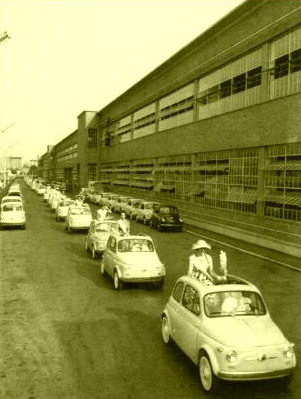


The 500 model range
Over the years Fiat brought various versions of the 500 to market. Between 1957 and 1975, improvements and changes were continually fed into production.
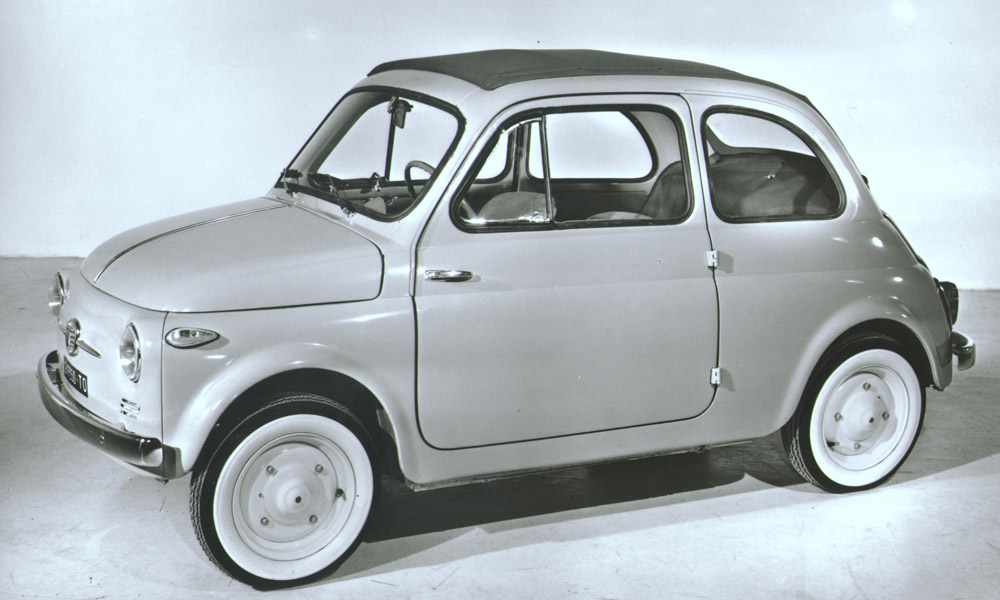
Derivatives
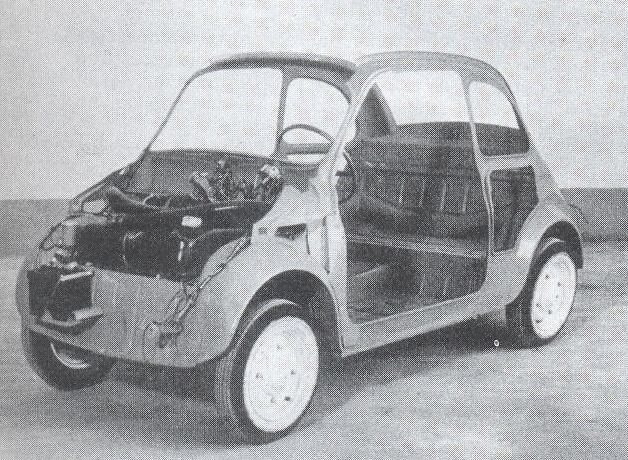
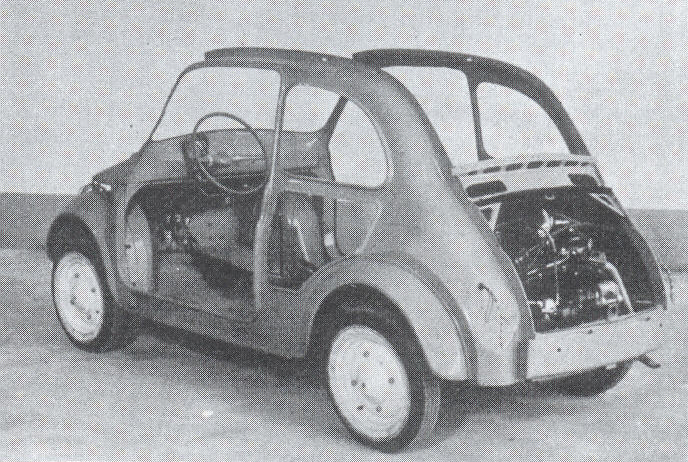
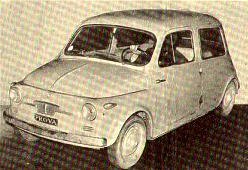
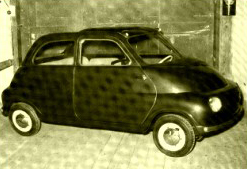
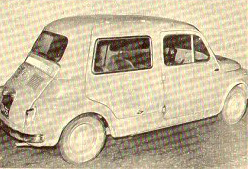
Fiat also sold the 500 as a bare bodyshell. This brought both beautiful and curious vehicles to market. Many companies tried their luck using the Fiat 500 as a base – some with less, others with more success. Many of these companies were never heard of again; a few became well known and still exist today.
A small car – and a great one
At roughly the same time as the German Reich government, in 1934, gave Porsche the commission to design a Volkswagen costing less than 1000 RM, and the professor set about devising the most successful automobile of all time, a small and far less spectacular car was being completed in Italy which, with more modest means, was likewise to become a kind of Volkswagen.
Unlike the German designer, who wanted to build an entirely novel vehicle and did not take his bearings from conventional models, it was enough for the engineers at the Fiat motor works in Turin, under the direction of Dante Giacosa and Antonio Fessia, to put on wheels a small car for two people with a large luggage space behind the seats, one that differed substantially from ordinary everyday cars of the period only in its external dimensions.
Small and economical
The car was to be driven by a small, economical engine, and it was consequently necessary to build it as light as possible in order to achieve acceptable performance all the same.
In those days it was still usual to build a car’s body separately and only later to set it on the load-bearing chassis. And so the saving of weight began with the chassis: the two side members which, together with cross-bracing, formed this frame were drilled out in a way otherwise really only common in racing and sports car construction. To save costs, and also because at that time it was not yet regarded as a sign of crudeness, the suspension turned out to be quite simple. A transverse leaf spring and transverse links tried to keep the front wheels cleanly on the road, while at the rear a rigid axle with quarter-elliptic cantilever springs provided anything but gentle springing; but everything was solidly and robustly built and easy to maintain.
Just as important as the car’s light construction was its rigorous use of space, in order to offer the future owner an optimum of possible uses. To this end the engine had been moved as far forward as possible – and that was perhaps the only unusual thing about the design of this car – so that the occupants could move well forward and there was still room behind the seats for luggage or small children. The whole car was after all only 3.21 metres long, an extremely short dimension for a car with a front engine and rear-wheel drive. The result was that the engine ended ahead of the front axle and the pedals lay at the height of the gearbox blocked to it. The little Fiat thus had plenty of room for the passengers’ legs and additionally offered some 80 per cent of its interior volume for use: an excellent figure.
It was further remarkable that the small 569 cc engine had four cylinders in line and thus spared its users the heavy vibration and rough running of the single- and twin-cylinder units otherwise readily fitted to small cars. The engine designers, on the other hand, contented themselves with a total of two crankshaft bearings, and it is not hard to imagine the flexing to which this component was subjected when the engine was working at 4000 rpm to produce the promised maximum output of 13 hp. Fortunately this rather gutsy and thoroughly flexible little four-cylinder hardly encouraged using the gears to the full, which in the long run would probably have caused great damage. But anyone who had worked his way up by means of the long central gear lever to fourth gear of a gearbox unsynchronised in the two lower ratios, yet light and precise to shift, could reckon on an honest 90 km/h at full throttle: a respectable figure for the mid-1930s, when everything that went faster than 100 km/h already counted among the sporting automobiles.
The engine’s temperature was looked after by simple thermosiphon cooling, and a fuel pump was saved because the tank, in front of the windscreen, lay high up under the body and fed the carburettor by gravity. Hydraulic brakes, by contrast, were not something the makers wished to do without.
By its external appearance too, the Fiat 500 that went into production in 1936 immediately won sympathy. The huge grille, which supplied air to the radiator arranged behind the engine, and the free-standing headlamps gave the stocky vehicle with its large wheels a cute look. It did not take long before the small, nimble and agile Italian had acquired its pet name “Topolino” (little mouse), and to this day this name is more familiar to most people than the correct designation Fiat 500 A.
The success of this well-executed design, which gave the ordinary man full-value motorisation, understandably did not keep anyone waiting long. Sales went splendidly not only in Italy; there was lively interest in the new Type 500 in Germany and France as well. Thus it came about that production of licence-built vehicles soon began both at NSU-Fiat in Heilbronn, a firm taken over by Fiat, and at S.I.M.C.A., an assembly plant for Fiat cars founded in 1935 at Nanterre. In Heilbronn the 500 was given a plywood body covered in imitation leather, and soon there was a charming little roadster to go with it, whose doorless body was created at the Weinsberg company. Indeed, the frame construction of the Fiat 500 invited all manner of special and custom bodies, and even during the Second World War, when almost all car manufacturers had stopped building civilian vehicles in favour of war materiel, the odd Fiat 500 A still came off the line, often with primitive and adventurous bodywork, since the shortage of materials called for a great deal of improvisation.
In 1948 the time came for the first improvements, even if they were not yet visible from the outside. Apart from a revised dashboard with the long-awaited fuel gauge there was nothing new to be seen: the Topolino B presented itself in its old clothes. Underneath, however, a good deal had happened. On the road an improved rear suspension with telescopic dampers and longitudinal semi-elliptic leaf springs made itself pleasantly felt, and the engine too now gave still more cause for delight, for overhead valves and a few power-raising measures now coaxed a lively 16.5 hp at 4400 rpm out of the little power plant, so that the 100 km/h mark was now within reach. By then there was also a van called the “Furgoncino” and an estate version known as the “Giardiniera” (gardener) or “Belvedere”, with splendid wood panelling as on the later DKW Universal, in order to serve small tradesmen and larger families as well.
The 500 B was, however, basically only an interim solution, for as early as 1949 there was a Fiat 500 C with a completely reworked and modernised body, though with the same mechanicals. The front and rear ends in particular had changed fundamentally. The old-fashioned tall radiator had been replaced by a steeply sloping front with transverse slots, and the headlamps were integrated into the deeply drawn-down wings. The tail was more strongly curved than on the old types, and the spare wheel no longer lay in a recess on top; unfortunately a boot lid was still lacking. The French offshoot named the Simca 6 had also been subjected to this cosmetic cure, but received a different radiator grille, and in 1952 the mixed-construction estate was replaced by an all-steel version. Although the Topolino was by then already more than twelve years old, sales only really took off at that point: between 1949 and 1955, the year the new 600 appeared, more than 376,000 examples of the 500 C were produced, an enormous increase compared with the good 141,000 500 A and B of the twelve years before. Long before 1955 work had begun at Fiat on a successor type. This time something special was to be presented: a small car that, at an even shorter length than the 500 C, could carry four people comfortably, still had room for luggage and could accelerate the whole thing properly without using much fuel.
Several years of intensive research and testing passed, during which numerous production-ready solutions were rejected again and replaced by better ones, before the veil was lifted in 1955 and the Type 600 was presented in Turin. Fiat had undoubtedly brought off a great coup, for beneath the plain sheet-metal shell (too plain for some tastes at the time) lay qualities that allowed the Type 600 to take a superior position in the international small-car offering. Doing without fashionable frills, the modern self-supporting body was distinguished by uncompromising practicality; wings were now only hinted at and gave away not a centimetre of valuable interior width. Minimal body overhangs enlarged the interior and, with a generous wheelbase, provided sufficient ride comfort. The shape could not be called pretty or original as on the Topolino, but it was uncommonly practical and well thought out. Naturally the car had to face strong competition at once in the shape of the Renault 4 CV and the Citroën 2 CV, though the former could not keep up in terms of bodywork and the latter in terms of performance. The VW Beetle, whose conception had started from similar ideas, ranked a class higher despite its low price, at least for the standard version, and was not among the direct competitors of the Fiat 600.
In July 1956, that is 16 months after its debut, licence production began at NSU-Fiat, where the car was given the new name “NSU-Fiat Jagst”. Under the steeply sloping tailgate there worked, as in the original, a 19 hp four-cylinder engine which made the car a good 100 km/h fast; an elaborate independent suspension front and rear, with wishbones and telescopic dampers, turned driving this thoroughly successful small car into a pleasant experience.
Inside, an almost spartan simplicity prevailed, yet every detail seemed of a piece, and one looked in vain for half-measures or makeshift solutions. The dashboard, painted in the body colour, was impressive for its clarity, and a large combined instrument directly in front of the driver brought together the most important readings. A central gear lever, short and precise to operate for a rear-engined car, transmitted the commands to the 4-speed gearbox located ahead of the rear axle, where only first gear still wanted to be indulged with double-declutching.
The seats were not too softly padded and gave sufficient lateral support. The backrest of the rear bench folded down, and one then had a large stowage space at one’s disposal, even for bulky goods. Anyone who wished could have his 600 fitted with a large sunroof opening as far as the rear window. The most that could be criticised was that the doors still opened towards the rear in the old tradition and that the car readily broke away at the tail in fast corners; in winter, moreover, it took quite a long time before the interior warmed up, since the heater worked without a heat exchanger.
The Fiat 600 had turned out to be exactly the right car for Italy. Production was running at full tilt, and assembly licences were soon granted to Spain, Austria and Yugoslavia, where the 600 came into being under the names Seat 600, Steyr-Fiat 600 and Zastava 600; the NSU-Fiat Jagst sold well too. It did not take long before numerous firms began to offer, often with great success, more powerful and visually enhanced versions of the Fiat 600; the firms Abarth and Giannini distinguished themselves in particular and conjured many a wolf in sheep’s clothing out of the 600. Even if the life of the robust short-stroke engine suffered as a result – a tuned “Seicento” provided a great deal of fun. Through a slight increase in compression the production 600 too gained one horsepower in March 1959, and from the summer of 1960 the capacity rose to 767 cc and the output to 25 hp, which benefited above all acceleration and flexibility, less so the top speed.
The bodywork changed little over the years. Soon after the start of production the impractical sliding windows were replaced by wind-down windows, which received quarter-lights from 1960; in 1964 the doors were at last hinged at the front, and larger, further protruding headlamps improved the light output. Reclining seats and a combined ignition and starter switch completed an equipment level that never sought to feign luxury. The Fiat 600 was a sensible car without airs.
In parallel these changes also affected the sister models in Germany, Spain and Yugoslavia, with small local differences: in Spain there was thus a four-door version with a lengthened wheelbase and an engine bored out to 800 cc, and the Zastava was finally available even with a 30 hp unit.
After exactly 15 years production of this popular type came to an end in Italy and in the Federal Republic of Germany; in Spain it could still be bought new until 1973 and in Yugoslavia even until the end of the 1970s. The Type 600 never had a production estate version, but it did have a people carrier based on the 600, already forgotten in this part of the world, by the name of “Multipla”. From 1956 this very unusual-looking six- to seven-seater was built in Italy and then in Austria as well; those sitting at the front sat over the front axle as in a delivery van. Behind them two more rows of seats could be accommodated, and taxi versions thus carried up to seven people, with the same engine output as the normal 600. Today these Multipla, with their bodywork tapering towards the rear like a teardrop, are among the rare representatives of the small Fiats; their production ended in 1967.
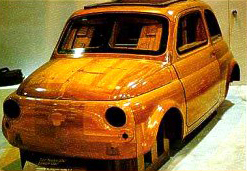
Ten years earlier, on 4 July 1957 to be exact, the Fiat 600 had been given a little brother that looked rather similar to it from the outside, but whose rear engine was of an entirely different kind. In order to be able to offer something to those motorists for whom even a 600 was too expensive, Fiat had developed the “Nuova 500”, which received the first air-cooled engine in the company’s history. From 479 cc the tiny twin-cylinder drew first 13, then soon 15 hp, and thus managed to make the dwarf-like four-seater, less than three metres long, 85 km/h fast.
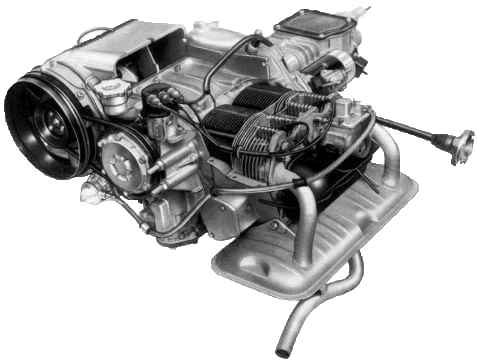
Inside, furnished entirely in the manner of the 600, two adults had comfortable room at the front, and on the rear bench two children or, at a pinch, adults (not too large ones) could be placed. In 1960 a pretty estate version of the 500 appeared, called the Giardiniera, with a lengthened wheelbase. Here the engine had been turned through 90 degrees in order to create a flat, continuous load floor. This version produced 17.5 hp, and from then on the normal 500 also received this engine and was called the 500 D.
Two years earlier a Fiat 500 Sport with this 17.5 hp engine had been presented; it ran to 105 km/h flat out. But the recognised tuning firms too took up the smallest Fiat and often conjured more than 30 hp out of the miniature engine. This Type 500, delivered as standard with a roll-back roof, was not built under licence at NSU-Fiat; between 1959 and 1963, however, there was a pretty special version of this type with a saloon or coupé body made by Weinsberg and a sliding roof. Of these NSU-Fiat Weinsberg 500, mechanically fully corresponding to the original, only 6190 were built, and the few surviving examples are sought-after collectors’ pieces today.
In March 1965 the 500 too finally received front-hinged doors and was from then on designated the 500 F. Engine output was now 18 hp, and Fiat left it at that right up to the end of production. By then a Fiat 500 derivative was also in production in Austria in the shape of the Steyr-Puch, though its drive came from a flat-twin of the firm’s own design. Later the body of this relative of the Fiat 500 was also subjected to a number of changes, from which the rear passengers in particular benefited thanks to a raised rear roof section. The little Steyr-Puchs with 500 and 650 cc engines became known above all for their numerous sporting successes in rallies and hill climbs, where the tiny cars with their highly tuned engines always caused a stir.