


Fiat - 100 years of history
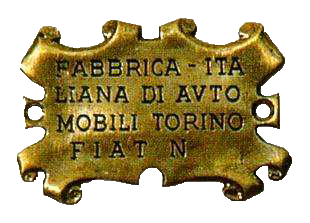
Fiat was founded in 1899. The name is an abbreviation and stands for “Fabbrica Italiana Automobili Torino”, which translates as “Italian Automobile Factory Turin”.
FIAT

As an industrial city full of innovation, Turin in northern Italy offered ideal conditions for a group like Fiat to grow and flourish. The cars, developed as luxury articles for a consumer elite, quickly became popular both in Italy and abroad. Soon nobody could get past Fiat in racing either. In 1909 Fiat opened a factory in the United States, where it built not only passenger cars but also lorries, tractors, trains, marine engines and aircraft.
In 1922 Fiat changed from an exclusive premium marque into one whose products were to become affordable for an ever growing number of ordinary consumers. The group felt challenged to fill a gaping gap in the US market with a simply motorised small car. A car for everyone. In the mid-1950s millions of the small Fiat models Seicento and Cinquecento came off the assembly line. Fiat had turned the car into a mass-market article and became the symbol of the Italian economic miracle.
History
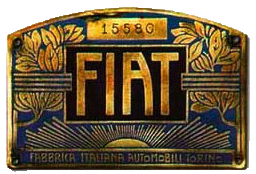
Fiat is one of the oldest car manufacturers and one of the richest in tradition. Its beginnings go back to the year 1898. In 1898 Giovanni Battista Ceirano signed a contract with a number of Turin businessmen with the aim of building an automobile prototype. Before that Ceirano had produced Welleyes bicycles. In March 1899 the first Welleyes car was presented. It had been designed by Aristide Faccioli. A two-cylinder engine of 663 cc drove the car through a two-speed gearbox. Four months later Ceirano’s company was bought by F.I.A.T. (Fabbrica Italiana Automobili Torino). The first Fiat was a further development of the Welleyes car, but it now had a boxer engine producing 3.5 hp. Like other members of Ceirano’s staff, Faccioli moved to Fiat as well, but he left the company around 1901. The management wanted to bring a model with a front engine onto the market, something Faccioli apparently could not come to terms with. The new engineer Enrico finally made it possible for the model desired by the management to be built in 1902. The new model now had four cylinders, with 4.2 litres a considerably larger capacity than the previous models, and its concept was influenced by Mercedes. In 1904 the iron-reinforced wooden frame of this car was replaced by a steel structure. In 1905 the engine was changed. It now produced 60 hp from 10,082 cc! A special feature was the water-cooled transmission brake. At the end of 1906 the full stops in the company name were dropped and from then on the vehicles appeared under the brand name Fiat. In 1907 the first six-cylinder model appeared, with 11,034 cc. It was started by means of a compressed-air starter. The first model to be sold in larger numbers was the Type Zero. The Zero was no capacity giant; it had only 1,846 cc and went into production from 1912. Today it is regarded as Europe’s first large-series car.
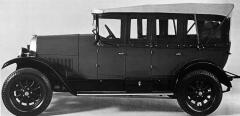
Fiat 501 (1919): four-cylinder in-line engine, 1,460 cc, 23 hp, mechanical four-speed gearbox, ladder frame, drum brakes at the rear only, top speed 80 km/h. Built as a saloon, tourer and sports car. Immediately after the end of the First World War the Fiat 501, developed by Cavalli, appeared. Production ran until 1926 and reached a total of 45,000 vehicles. Alongside it ran the production of a luxury car with a V12 engine and 6.8 litres capacity, which was a commercial failure. From 1921 to 1923 only 30 were built.
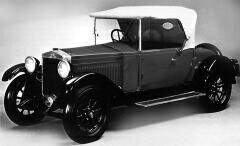
In 1925 the Fiat 509 appeared, with an overhead camshaft and a flat radiator. In 1929 the 509 was replaced by the Type 514. But the 514 turned out to be a flop again. The beginning world economic crisis probably contributed a good deal to the fact that only a few 514s could be sold.
Fiat 509 Spider of 1925: four-cylinder in-line engine, overhead camshaft, 990 cc, 20 hp, mechanical three-speed gearbox, ladder frame, four-wheel brakes, 80 km/h top speed. Built as a sports car, tourer, spider, sedan and cabriolet. At the end of the twenties larger models were added again: the Type 525 and the Type 521 had 6-cylinder engines of 3,740 and 2,516 cc respectively. The Type 521 was the first Fiat with hydraulic brakes.
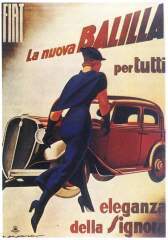
Advertising poster for the Fiat Balilla – entirely in the style of the 1930s.
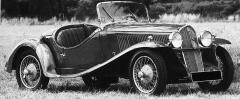
In 1932 Fiat presented the Type 508 Balilla, which became a successful model. The name was chosen out of political expediency; Balilla was a fascist youth organisation in Italy. The Balilla had overhead valves, 25 hp in the tourer version and 36 hp in the sports version. The sports version was usually fitted with a body by Ghia. Under licence the Balilla was produced by NSU in Germany, Walter in Czechoslovakia, at Polski-Fiat and in France at Simca. Simca brought it out in a version by Gordini.
Fiat 508 S Balilla Sport of 1933: 4 cylinders, overhead valves, 995 cc, 35 hp, mechanical four-speed gearbox, four drum brakes, 120 km/h. In 1936 the model 1500 appeared with an aerodynamic body and independent suspension. In 1937 production began of the Type 1100, which was a modified 508 and now had independent suspension.
One of the most successful models appeared as early as the end of 1936: the Fiat Topolino