


Philips
N.V. Philips’ Gloeilampenfabrieken, Eindhoven
Head office:
Eindhoven, Netherlands
(today Amsterdam)
Philips was founded in Eindhoven on 15 May 1891 by Frederik Philips and his son Gerard to make incandescent lamps; Gerard’s brother Anton joined the firm in 1895. In 1912 it became the public limited company N.V. Philips’ Gloeilampenfabrieken.
From 1918 Philips made radio valves, from 1927 complete radio sets and from 1934 car radios as well. In 1963 the company presented the Compact Cassette at the Funkausstellung in Berlin.
At the end of the 1990s the head office moved to Amsterdam; since 2013 the company has been called Koninklijke Philips N.V. The television business passed to TP Vision in 2012, the audio and video business to Gibson Brands in 2014, and the lighting division was split off in 2016 – today it is called Signify. Today Philips works mainly in medical technology.
Philips car equipment
How to tell the Auto-Mignon models apart
- AG 2101 / MK 60: the first model, presented at the Hanover Fair in 1959. AG 2101 is the Philips type number; in Germany the unit was called MK 60 (1959–1963, 148 DM). 6-volt motor, switchable to 12 volts; AG 3113 crystal cartridge. On the type plate the number is followed by suffixes such as D/01, D/24, D/25 or D/a; there were versions for 6, 12 and 24 volts.
- MK 60 T: the successor in Germany, 1963–1971, 179 DM. Set for 12 volts at the factory, 24 volts with a resistor box; tropicalised cartridge, 50–12,000 Hz.
- 22 GA 101: new Philips type number from about 1965 (versions /51 and /53), adjustable to 6, 12 or 24 volts. In Germany the Auto-Mignon was still offered in 1971/72 as the GA 101.
- Norelco: in the United States Philips sold the Auto-Mignon under the Norelco brand.
- All of them play only 17 cm singles at 45 rpm and play back through the car radio.
Auto-Mignon AG 2101
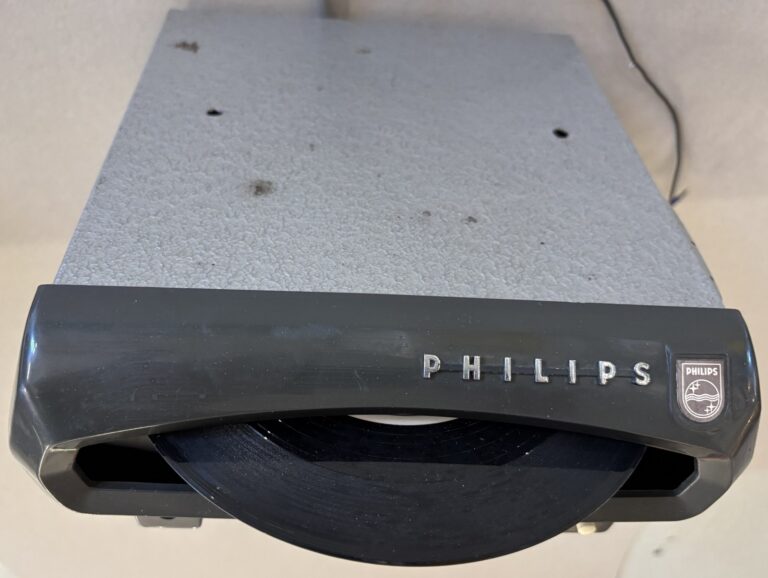
Philips presented the Auto-Mignon at the Hanover Fair in 1959. It is an automatic record player for singles, screwed in under the dashboard. You push the record into the lit slot; switching on, cleaning the stylus, lowering it, playing, switching off and ejecting are all automatic. Sound comes through the car radio: a five-pin plug carries the signal and the power supply, and because car radios of the time had no phono input, Philips supplied an adapter lead to be soldered in ahead of the radio’s amplifier. One button switches from radio to record, a second stops playback and ejects the record. So that the stylus does not jump on bends or bad roads, the mechanism hangs freely on three compression springs and is driven by two counter-rotating friction wheels.
| Records | 17 cm, 45 rpm |
|---|---|
| Drive | DC motor with centrifugal governor, two counter-rotating friction wheels, wow 0.5 % |
| Power supply | 6 volts, switchable to 12 volts; about 50 mA at 6 volts |
| Cartridge | AG 3113 crystal, 30–15,000 Hz, tracking force 10 g |
| Dimensions, weight | 23 × 14 × 24.5 cm, 4.3 kg |
| Price | 148 DM (Germany, 1959); 1,390 schillings (Austria, 1962) |