

Laika
LAIKA
Works: Tavarnelle Val di Pesa (Firenze)
Office: Via Guido Monaco 32, Firenze
The story of the traditional Italian brand Laika Caravans is closely bound up with the spirit of new beginnings and the enthusiasm for space travel in the 1960s.
🚀 The beginnings of Laika (1964)
Laika was founded in 1964 by Giovambattista Moscardini at Tavarnelle Val di Pesa in Tuscany. The present seat at San Casciano in Val di Pesa dates only from February 2016.
Name & logo: Moscardini was fascinated by space research. He named the company after the dog Laika, the first living creature in Earth orbit (1957). As its emblem he chose a red winged greyhound. Alongside it, Laika used from the start the LAIKA wordmark in speed stripes, the one on the brochures and the letterhead — and the one shown at the top of this page.
Philosophy: the aim was to build compact, futuristically styled and extremely functional caravans that could also be towed by small Italian cars.

🛠️ The legendary Laika 500 (1964)
The Laika 500 was the manufacturer’s very first model and a genuine design innovation in camping.
Special features & technology:
- Developed for the Fiat 500: the small Fiat 500 shaped Italy’s streets at the time, but had very little engine power. The Laika 500 was built so light and so aerodynamic that it could be towed by a Fiat 500 without any trouble.
- Lowerable telescopic roof: the heart of it was the mechanical lifting, or telescopic, mechanism. While driving, the upper part of the caravan could be lowered:
- Height closed (on the road): approx. 1,55 m
- Height open (parked): approx. 2,25 m (full standing height inside)
- Light weight: the factory brochure gives a single figure: 300 kg fully laden. No unladen weight is recorded anywhere.
- Space wonder: despite its dimensions (body length approx. 2,31 m) it offered berths for up to 3 people (a double bed and a child’s bed) as well as a kitchen unit.
🏔️ The Laika 1000
The success of the Laika 500 was followed shortly afterwards by the larger Laika 1000 model.
- Concept: while the Laika 500 was tailored to the absolute minimum for the Fiat 500, the Laika 1000 was aimed at families and at owners of somewhat more powerful tow cars (such as the Fiat 1100 / 1000 class).
- More comfort: the Laika 1000 offered considerably more interior space, more extensive kitchen and cupboard fittings and a larger area for standing and sleeping.
- Construction: here too Laika relied on the rounded, well-insulated lightweight GRP construction (glass-fibre reinforced plastic) that is still regarded today as the hallmark of historic Laika trailers.
🚐 How the brand developed
- 1977 – The first motorhome: after the successful caravan series, Laika entered the market for motorised campers with the Motorpolo model.
- 1992 – Ecovip series: with the presentation of the legendary Ecovip range, Laika finally established itself in the premium segment.
- Since 2000: Laika belongs to the German Erwin Hymer Group. Production still takes place in San Casciano in Val di Pesa in Tuscany.
Laika in France
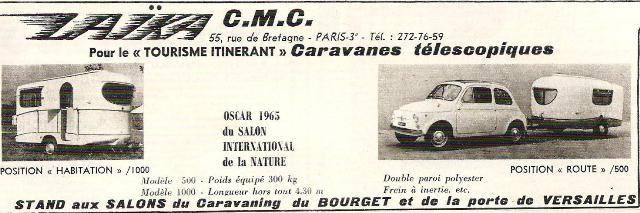
In France Laika was distributed by C.M.C., 55 rue de Bretagne in Paris, as caravanes télescopiques. The advertisement lists an award: the Oscar 1965 of the Salon International de la Nature. It was shown at the Salons du Caravaning at Le Bourget and at the Porte de Versailles.
The letterhead
The back of the brochure separates works and offices: Stabilimento Tavarnelle Val di Pesa (Firenze) and Direzione commerciale, Via Guido Monaco 32, Firenze. In small print at the foot: printed by Grafiche Nencini at Poggibonsi, photographs by Foto Mario, Florence.